Verification and reproducibility study
Reconciling Nondimensional Forms of the Decaying Taylor Green Vortex
A reproducible symbolic and dimensional verification
Disclosure: The author, Qonduit Limited NZ, Haivian Technology and both journals operate within a common ownership and governance relationship. Journal placement is not independent external endorsement.
Rights boundary: This article and its original figures are licensed under CC BY 4.0. That licence does not cover the Airbus challenge statement, Airbus logos, screenshots or other third-party material, none of which is reproduced here. Airbus did not review, approve or endorse this work.
Exact version identity
- Web article version
- 2.0 · 2026-10-16
- Source SHA-256
9da64e82d07f757d0c5b1a70ce350fb2d66d3c2a5d8fd95a20dfa1c61d33f212- PDF SHA-256
07501ca97379ee2484c0f806474a1f9c2d53f5f825aa7fa14de73291ebd55bca- PDF pages
- 11
Abstract
The exact decaying two-dimensional Taylor vortex is a useful reference field, but its numerical interpretation depends on which length defines the trigonometric phase, the computational domain and the Reynolds number. We separate these roles as the vortex scale , square-domain side and Reynolds reference length . Starting from dimensional incompressible flow, we state the complete nondimensional map and derive a translated viscous vortex whose continuity, momentum and pressure-Poisson residuals vanish identically. We then compare two periodic interpretations under an explicitly assumed axis-aligned periodic square: a vortex-scale convention with , and a domain-scale convention with . At an equal numerical Reynolds label they assign different viscosities and decay rates; at equal physical viscosity they coincide under . We also distinguish physical pressure from kinematic pressure , for which the correct Poisson equations differ by a density factor. A literal identification remains a local solution of the differential equations but is incompatible with the assumed periodic square when the perturbation is nonzero. Full-period invariants, analytical numerical fingerprints and fixed Fourier support provide additional checks. A fresh private reanalysis reproduced the central formulas with 28 executable checks, including deliberately defective controls; archived historical check totals are reported separately as documentary provenance rather than new mathematical evidence. The result is a bounded reconciliation of conventions, not a new vortex solution, numerical-solver validation, turbulence result, industrial-flow study or statement of Airbus intent.
Version lineage and scope
This article is version 2.0. It revises a frozen version 1.0 manuscript dated 12 October 2026, identified by SHA-256 e8bf95f686889a9ac75a8593f33a8ad2e76b76ea5da62907a826ba22abb71a51. The mathematical reconciliation is retained, while the nondimensional mapping, benchmark parameters, boundary attribution, energy units, Reynolds-number scope, historical provenance and figure specifications are corrected or clarified following a fresh private audit. Evidence generated for version 1.0 is not presented as blanket validation of this revision. A targeted revision check is a separate publication-control step.
This publication edition adds journal links, licence terms, exclusions and publication metadata to the reviewed prepublication version 2.0. It makes no scientific changes and records no new audit. The related validation article preserves the exact prepublication source and PDF identities examined in the targeted revision check; the publication edition has separate source and PDF identities in its release ledger.
1. Introduction
Exact solutions isolate definitional and implementation errors before discretization error enters. They are also sensitive to notation. A symbol used for a box size, a trigonometric wavelength parameter and a Reynolds-number reference length may represent quantities with the same dimensions but different mathematical roles. If those roles are collapsed, two analysts may use the same numerical Reynolds label while assigning different viscosities, or may verify a field locally while overlooking incompatibility with an assumed periodic box.
The two-dimensional decaying vortex predates the later three-dimensional Taylor–Green construction. Taylor treated viscous vortex decay in 1923, whereas Taylor and Green studied the production of smaller eddies from a three-dimensional periodic initial field in 1937 [1,2]. Modern literature often calls the exact two-dimensional benchmark the “Taylor–Green vortex,” although “Taylor vortex” is historically more precise [3]. No new exact solution is claimed here.
This study examines a locally retained inspected copy of a publicly posted Airbus challenge statement in which the symbol appears as a vortex length in the phase and decay formulas and later as a domain length and Reynolds-number reference length [9, pp. 6–9]. The source supplies numerical values but does not expressly prescribe the periodic square used in the present analysis. Accordingly, the axis-aligned periodic domain, half-open origin convention and one-period interpretation are analysis assumptions, not statements attributed to Airbus. The current public Airbus programme page provides only general programme context and is not treated as the historical source document [8].
Our contribution is deliberately narrow: (i) separate the three length roles; (ii) define a self-contained dimensional-to-nondimensional map; (iii) derive the translated exact field and its pressure interfaces; (iv) reconcile two finite positive-Reynolds conventions; (v) distinguish local differential validity from periodic compatibility; and (vi) record bounded symbolic, dimensional and arithmetic checks. The work addresses reproducibility of interpretation, not numerical accuracy, physical validation or organizer intent.
2. Governing equations, notation and scaling
2.1 Dimensional equations
For constant density , constant kinematic viscosity , and dimensional velocity , the incompressible equations are
Here is physical pressure. With kinematic pressure , the pressure force per unit mass is . The distinction is standard in incompressible-flow software and documentation [6,7].
Let denote the side of the square domain, the vortex scale used in phases and derivatives, and the reference length used in the Reynolds number
The perturbation speed , translation components , and pressure gauge are constants. Equal dimensions do not make , and interchangeable [4,5].
2.2 Explicit nondimensionalization
Choose a fixed reference length and speed . Define
with , , , and correspondingly scaled translation velocities. Substitution gives
Sections 3–5 retain dimensional physical-pressure notation unless a quantity is explicitly starred. Section 6 evaluates the nondimensional numerical profiles and suppresses stars there for readability, with . The one-period interpretation takes and ; the literal single-length interpretation instead takes in the same coordinates.
2.3 Source parameters and analysis assumptions
The challenge statement supplies the numerical normalization
and gives a numerical length with [9, p. 8]. Because the same source symbol is also used as a vortex length in phase and decay expressions [9, p. 7], the role of must be resolved before reproducing the plots. For the periodic comparison we assume an axis-aligned square with opposite faces identified. This periodicity and the assignment in the one-period interpretation are analysis assumptions. They are not represented as explicit source boundary conditions.
3. Exact translated vortex family
Let
The translated field is
Equivalently,
The constant pressure gauge could be replaced by a spatially constant function of time without changing momentum; constant is the narrower convention used here.
3.1 Continuity, translation and diffusion
Writing , direct differentiation gives
so continuity vanishes identically. Moreover,
The moving phase cancels advection by the constant translation, and the exponential amplitude supplies the viscous decay. This componentwise argument remains valid when ; no division by the perturbation amplitude is required.
3.2 Nonlinearity and pressure
The perturbation self-advection is
The physical pressure gives
which equals the nonlinear acceleration on the left-hand side of the momentum equation. Equivalently, the nonlinear term and cancel when the equation is written as a zero residual. The remaining momentum residual is proportional to .
Define
The dimensionally consistent Poisson interfaces are therefore
| Pressure variable | Momentum force | Poisson equation | Units |
|---|---|---|---|
| physical | pressure | ||
| kinematic | velocity squared |
The source uses physical pressure in its momentum equation, omits in a displayed Poisson equation, and includes in its pressure field [9, pp. 6–7]. At the supplied value , the physical- and kinematic-pressure expressions are numerically identical. At general density they are not. We therefore identify a qualified pressure-interface ambiguity without assigning intent to the source authors.
4. Continuous invariants and dimensional interpretation
On a rectangular torus containing whole velocity periods along both axes, continuous spatial averaging gives
The mean specific kinetic energy and its perturbation component are
with
The scalar vorticity and physical-pressure extrema are
Full-period averaging guarantees these identities independently of translation phase. It is sufficient, but not logically necessary for every accidental equality on a smaller window. Truncated or moving windows do not generally retain the same means, and arbitrary discrete or finite-volume averages require separate analysis.
Because is specific energy, is kinetic-energy density per unit volume. On a two-dimensional rectangle of area , the area integral is energy per unit out-of-plane depth. On the square used below this becomes ; it is not a three-dimensional total energy unless a physical depth is separately specified.
5. Periodic compatibility is separate from local PDE validity
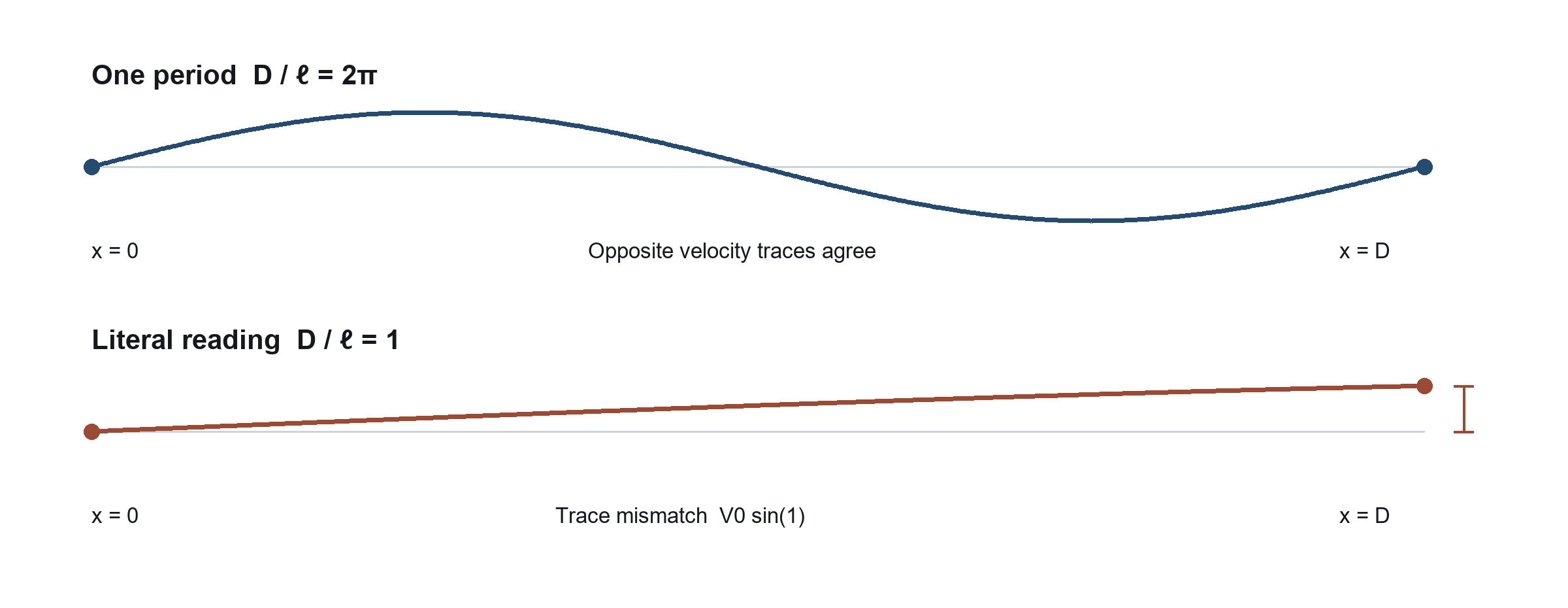
Assume a nonzero perturbation on the axis-aligned square torus . Equality of the velocity traces on opposite faces requires and is ensured by
Translation changes the phase but not this criterion. Pressure alone cannot certify velocity compatibility because its axial period is , half the velocity period.
Under the one-period interpretations, and , so the phase advances by across each side. Under the literal single-length reading, , so the phase advances by one radian. At ,
which is nonzero for . The literal field remains a local solution of the differential equations, but it is incompatible with the assumed periodic square. At the perturbation vanishes and the restriction is unnecessary.
6. Reynolds-number reconciliation
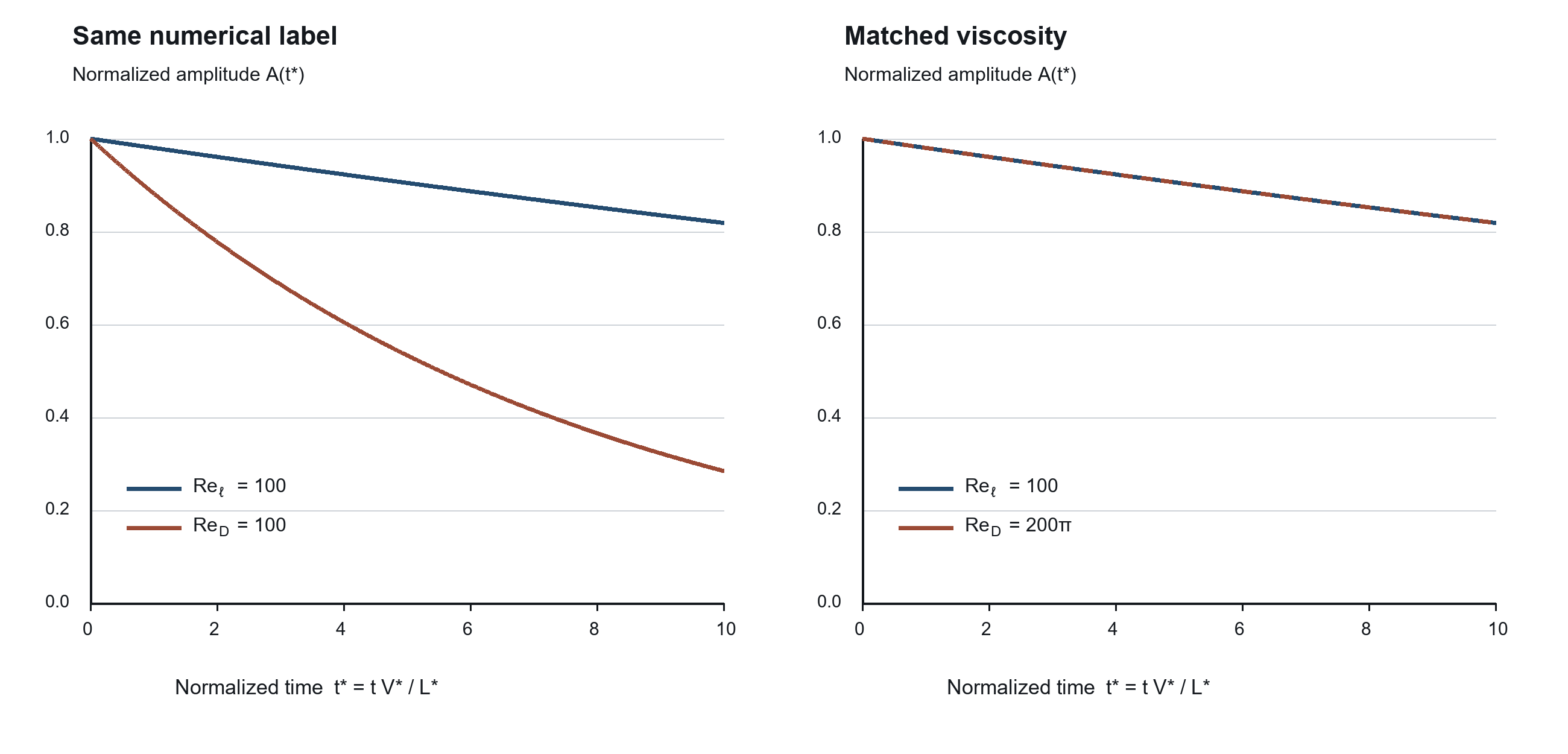
For and , define finite positive labels
When ,
The following table uses the nondimensional coordinates of Section 2 with and .
| Interpretation | normalized amplitude | periodic status | ||||
|---|---|---|---|---|---|---|
| vortex-scale periodic | compatible | |||||
| domain-scale, plot-consistent periodic | compatible | |||||
| literal single-length | incompatible with the assumed square when ; diagnostic only |
At the same numerical label , the two periodic interpretations assign viscosities differing by , and therefore decay differently. At matched physical viscosity, common geometry, common speed and common time units, and the two descriptions give the same physical field. This identity is a relabelling check, not a second independent experiment.
The exact family also admits and . The former is the inviscid, nondecaying limit; the latter is the trivial constant-velocity field. The quotient comparison above is restricted to and , where both finite Reynolds labels are defined.
6.1 Analytical fingerprints
Using the complete source normalization , , , , , together with the plot-consistent periodic interpretation , and , the exact formulas give
and
The time coordinate is the scaled coordinate defined in Section 2. For the comparison above, the source figures' numerical time labels are interpreted as the corresponding values of under the chosen normalization. The source images label their times in seconds but do not define the reference ratio ; this comparison therefore does not assert a direct physical equality between those seconds and . The images are qualitatively consistent with a pressure magnitude near at the first time and energy near at the second [9, pp. 8–9]. The displayed digits are analytical evaluations, not measurements digitized from those images. Qualitative agreement supports the interpretation but does not establish official intent.
7. Fixed Fourier support
The nonconstant velocity perturbation contains only the angular wavevectors . The nonconstant pressure contains and . The uniform velocity and pressure gauge supply zero modes. Translation multiplies coefficients by phases, viscous decay changes their amplitudes, and neither operation creates new spatial support.
At fixed speed, geometry and Reynolds convention, increasing a positive Reynolds number lowers viscosity and slows the amplitude decay. It does not create smaller spatial scales in this exact smooth family. These statements concern the continuous field, not a discrete spectrum on an incompatible truncated box. No conclusion about turbulent cascade, numerical mesh demand or industrial-flow complexity follows.
8. Verification method and evidentiary status
8.1 Fresh private reanalysis of version 1.0
A fresh, human-directed private review rederived the field and executed a new standard-library checker against the frozen version 1.0 manuscript. The checker represented normalized spatial fields with exact rational Fourier coefficients and used a separate 100-digit decimal evaluation for the two numerical fingerprints. It completed 28 checks, including continuity, pressure balance, velocity Laplacians, pressure-Poisson, continuous moments, non-unit-density behavior, periodic trace tests, matched-viscosity equivalence and rounded fingerprints.
The suite also required rejection of deliberately wrong pressure signs and factors, a wrong decay rate, density-free physical-pressure Poisson at non-unit density, omitted translation compensation, and a half-period velocity trace. These controls show sensitivity to specified defects. They do not constitute 28 independent theorems, a physical experiment, a security proof or an estimate of an unknown error population. The decimal reference was high precision but not interval certified. General dependence on parameters and time follows from the derivation in Sections 3–6, not from a finite normalized test list.
The fresh reviewers were procedurally separated AI contexts of the same provider operating under responsible human direction. Their work was not external human peer review, provider-diverse review or execution of a native consensus kernel. The fresh review supported the central mathematics and required the substantive reporting revisions now made in version 2.0; it did not issue an unqualified validation of the whole manuscript.
8.2 Archived historical records
Version 1.0 also reported historical archived verification totals. Documentary inspection found the following actual denominators and recorded outcomes:
| Archived evidence class | Recorded result | Denominator meaning |
|---|---|---|
| exact and profile checks | 132/132 true | 16 exact, 1 source-density, 4 algebra, 5 unit, 100 profile, 2 literal, 2 mapping, 1 higher-Re decay and 1 fixed-support assertion |
| comparison, mutation and integrity checks | 203/203 true | 6 clean controls, 57 negative controls and 140 integrity records |
| assumption and source checks | 42/42 true | 23 assumption records, 18 source-binding checks and 1 aggregate preservation check |
The 57 negative controls included documentary and identity mutations as well as scientific defects. The single aggregate preservation assertion covered ten conflict qualifications; it was not ten separate checks. Current hash and byte-length agreement was confirmed for 25 payloads in the archived manifest. Those facts establish correspondence with inspected archive bytes, not authorship, organizer authentication, immutable history or independent chronology.
The historical records describe staged read separation and an independently authored checker, but the available seals did not independently timestamp every stage. No trusted platform chronology was inspected in the fresh review, and the historical checker was not rerun as its acceptance oracle. The counts therefore remain documentary provenance associated with version 1.0, not a substitute for the derivation and not blanket audit credit transferred to version 2.0.
9. Reproducibility and availability
The scientific reconstruction requires the equations, parameter map and assumptions stated in this article. The fresh private checker and its recorded output are retained with the private audit evidence. A sanitized standalone checker, expected-results file and compact scientific negative-control set have been prepared for owner release review, but are not included in this paper-and-figures release. The publication package separately supplies a release hash ledger generated after its artifacts were finalized. Public availability is not claimed for the checker or private audit evidence.
The publicly posted challenge statement is cited by document identifier, digest and relevant pages of the locally retained inspected copy so that the inspected source is distinguishable from the current programme website. Public access does not itself authorize redistribution, and the source is not redistributed with this manuscript. Internal task identifiers, local filesystem locations, authority records and non-public governance material are intentionally omitted because they are not needed to understand the mathematics.
10. Limitations
- Neither periodic interpretation is certified as the challenge organizer's intended convention.
- The axis-aligned periodic square, half-open origin convention and assignment are analysis assumptions.
- The square compatibility condition is stated for a nonzero perturbation; the constant-velocity endpoint is separate.
- The Reynolds reconciliation concerns common physical scales and finite positive labels. The inviscid and zero-amplitude endpoints are limiting or degenerate cases.
- No numerical PDE trajectory, solver, convergence study, finite-volume reference, matched-accuracy comparison or mesh study was run.
- Analytical fingerprints are not digitized plot measurements or physical validation.
- Full-period identities concern continuous spatial averages and do not certify arbitrary truncated windows or discrete schemes.
- The fixed Fourier support does not support a turbulence, industrial CFD, aircraft-geometry, hardware, resource-advantage or quantum-advantage claim.
- Hash agreement and recorded check totals do not establish external peer review, organizer endorsement or publication rights.
11. Rights, authorship and disclosures
11.1 Rights and non-endorsement
The equations, tables and figure specifications in this article are independently presented. The manuscript does not reproduce pages, screenshots or logos from the publicly posted challenge statement. Airbus did not review, approve or endorse this manuscript. The current Airbus programme page is cited only for general context [8]; it is not represented as the exact historical source [9]. Public access to the challenge document does not itself authorize redistribution. Redistribution of that document or non-public audit evidence requires separate rights clearance.
This paper and its original figures are licensed under [Creative Commons Attribution 4.0 International (CC BY 4.0)](https://creativecommons.org/licenses/by/4.0/). The licence excludes the Airbus challenge/source document, Airbus logos, screenshots, raw/internal records and all other third-party material. None of those excluded materials is reproduced in this paper-and-figures release. The licence does not grant rights in excluded materials or imply endorsement.
11.2 Author contribution and responsible oversight
Richard Janutka directed the scope, supplied the source materials, set the authorship and disclosure requirements, and retains responsibility for the decision to submit and for the integrity of the final article. AI systems assisted with evidence indexing, mathematical review, executable checking, drafting and document preparation under human direction. Separate same-provider AI contexts were used for targeted review, but this does not constitute external human or institutionally independent peer review.
11.3 Competing interests and common ownership
The author is affiliated with Qonduit Limited NZ. The author, the research and audit services involved in preparing this work, and the Haivian Research Journal and Haivian Validation Journal operate within a common ownership and governance relationship. Haivian Technology participated in the related audit and publication workflow. This relationship creates an institutional and commercial interest that readers should consider when evaluating the work. Publication in a commonly controlled journal must not be presented as independent external endorsement.
11.4 Data and code availability
The challenge statement was publicly posted; the locally retained inspected copy is identified in Reference 9 but is not redistributed here. Full internal audit evidence remains non-public. No public code or data repository is claimed. A sanitized reproducibility package has been prepared for owner review and may be released only after rights clearance; until then, the derivations and exact benchmark values in this paper define the public scientific content.
12. Conclusion
The apparent conflict between the two nondimensional profiles is resolved once geometry, vortex wavelength and Reynolds reference length are named separately. On the assumed one-period square, the vortex-scale and domain-scale labels differ by : they give different viscosities at the same numerical label but the same physical field at matched viscosity under . The same analysis distinguishes physical from kinematic pressure, and local differential validity from compatibility with an assumed periodic boundary.
The central result is exact but bounded. It is a reconciliation of conventions for a smooth analytical family, supported by direct derivation, discriminating counterexamples and fresh executable checks. It does not decide source-author intent, validate a numerical solver or support broader claims about turbulence, industrial performance or quantum computation.
References
- Taylor GI. On the decay of vortices in a viscous fluid. Philosophical Magazine. 1923;46(274):671–674. https://doi.org/10.1080/14786442308634295
- Taylor GI, Green AE. Mechanism of the production of small eddies from large ones. Proceedings of the Royal Society A. 1937;158(895):499–521. https://doi.org/10.1098/rspa.1937.0036
- Antuono M, Marrone S. Weakly compressible approximation of the Taylor–Green vortex solution. Studies in Applied Mathematics. 2025;154(1):e12792. https://doi.org/10.1111/sapm.12792
- Reynolds O. An experimental investigation of the circumstances which determine whether the motion of water shall be direct or sinuous, and of the law of resistance in parallel channels. Philosophical Transactions of the Royal Society. 1883;174:935–982. https://doi.org/10.1098/rstl.1883.0029
- Buckingham E. On physically similar systems; illustrations of the use of dimensional equations. Physical Review. 1914;4:345–376. https://doi.org/10.1103/PhysRev.4.345
- OpenCFD Ltd. Kinematic pressure. OpenFOAM Documentation. https://doc.openfoam.com/2312/tools/processing/solvers/algorithm-kinematic-pressure/
- OpenCFD Ltd. Pressure function object. OpenFOAM Documentation. https://doc.openfoam.com/2312/tools/post-processing/function-objects/field/pressure/
- Airbus. Airbus Quantum Challenge 3.0. https://www.airbus.com/en/innovation/digital-transformation/quantum-technologies/airbus-quantum-computing-challenge. Public programme context only; not the historical source examined here.
- Airbus. Challenge statement, version F [publicly posted challenge statement; locally retained inspected copy; file identifier
Airbus-Challenge-Statement-vF.pdf]. Relevant pp. 6–9. SHA-2564a2e084dd25d49343c98475091eede479513779c4306e90260f9b9cf518f77c6. Public access does not itself authorize redistribution; not distributed with this article. No exact current official URL is asserted.