A Neural Reconstructor Localises Hard X-Ray Sources in Simulation
A new arXiv preprint maps coded-aperture detector counts directly to source positions, reporting strong exact-pixel accuracy under simulated Swift BAT conditions while leaving flight validation open.
Direct answer
Has AI replaced coded-aperture reconstruction for hard X-ray telescopes?
No. A new preprint reports a neural alternative that localised simulated Swift BAT sources with more than 93% exact-pixel accuracy in one zero-background setting and at least 90% with specified added background. The work is a simulated demonstration, not a validated replacement for flight reconstruction pipelines.
What happened
Shayla Sharmin and Branden Allen have posted a preprint describing a neural image-reconstruction method for hard X-ray coded-aperture instruments. Their initial demonstration uses simulated responses from selected observations of NASA's Swift Burst Alert Telescope.
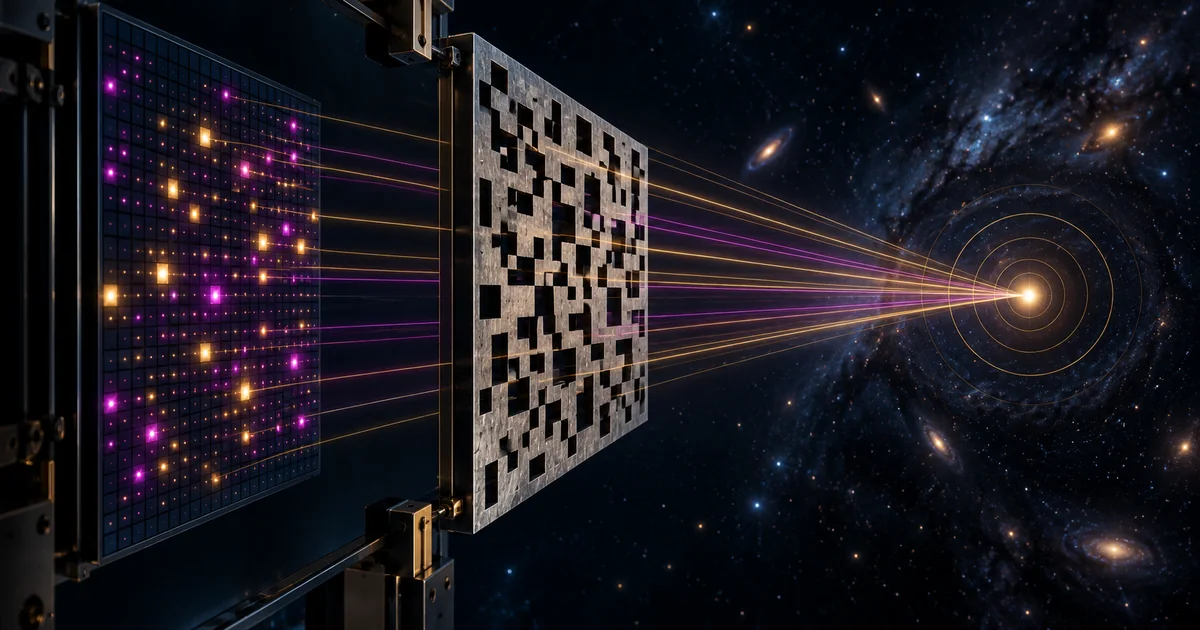
Coded-aperture instruments do not focus high-energy photons with ordinary mirrors. A patterned mask casts a shadow on a detector, and the source location must be reconstructed from that indirect measurement. Standard pipelines often use correlation or fast Fourier transform methods.
How AI was actually used
The authors trained a network with convolutional feature extraction and attention to map detector counts directly to source positions. The model was trained around 900 source counts. In the evaluated region, it reportedly exceeded 93% exact-pixel localisation with 400 detected source photons when no background was added.
At 900 detected source photons, the paper reports at least 90% exact-pixel accuracy with up to 8,500 added background counts. The model does not require the mask pattern to be supplied explicitly at inference; it learns the instrument response represented in the simulated training data.
Why it matters
If the approach survives broader tests, direct learned reconstruction could support low-latency processing on spacecraft and relax some geometric constraints on future hard X-ray and gamma-ray imagers. Embedded reconstruction matters when downlink is limited and rapid localisation is scientifically valuable.
The result is also a useful test case for AI-enabled scientific instruments. A network can absorb detector behaviour that is awkward to express analytically, but that same dependence can hide brittleness when the real instrument drifts away from simulation.
What remains unproven
The paper is arXiv version 1, submitted 15 October 2026. The headline results come from simulation and a defined part of BAT's field of view. They do not establish accuracy on flight data, across multiple sources, outside the tested region, under detector ageing, with unmodelled backgrounds, or after hardware and calibration changes.
Exact-pixel accuracy is only one metric. Operational validation would need angular error distributions, false-localisation rates, uncertainty calibration, latency and power measurements, stress tests across source spectra and intensities, and comparisons with the incumbent pipeline under identical conditions.
An independent audit would freeze the simulation generator and split logic, check for leakage between training and test responses, rerun all noise regimes, and test out-of-distribution instrument states. Haivian has not audited the preprint.
Primary sources and version boundary
- Sharmin and Allen, arXiv:2610.22709v1, submitted 15 October 2026.
- DataCite DOI record for the arXiv preprint.
For simulated performance claims that must survive independent reruns and distribution-shift tests, see Haivian's AI research audit and computational reproducibility audit.
Bounded audit pathway
Need a claim examined before publication?
Haivian offers scoped research audits with explicit evidence, limitations and accountable human sign-off. Payment does not purchase a positive result or publication.
Explore research audits