Microrobots Learned to Navigate Simulated Capillaries. The Bloodstream Is Still Ahead.
A reinforcement-learning policy transferred across simulated robot sizes and flow conditions, then blocked and cleared model capillaries without retraining—but every intervention remained in simulation.
Direct answer
What did the microrobot policy actually accomplish?
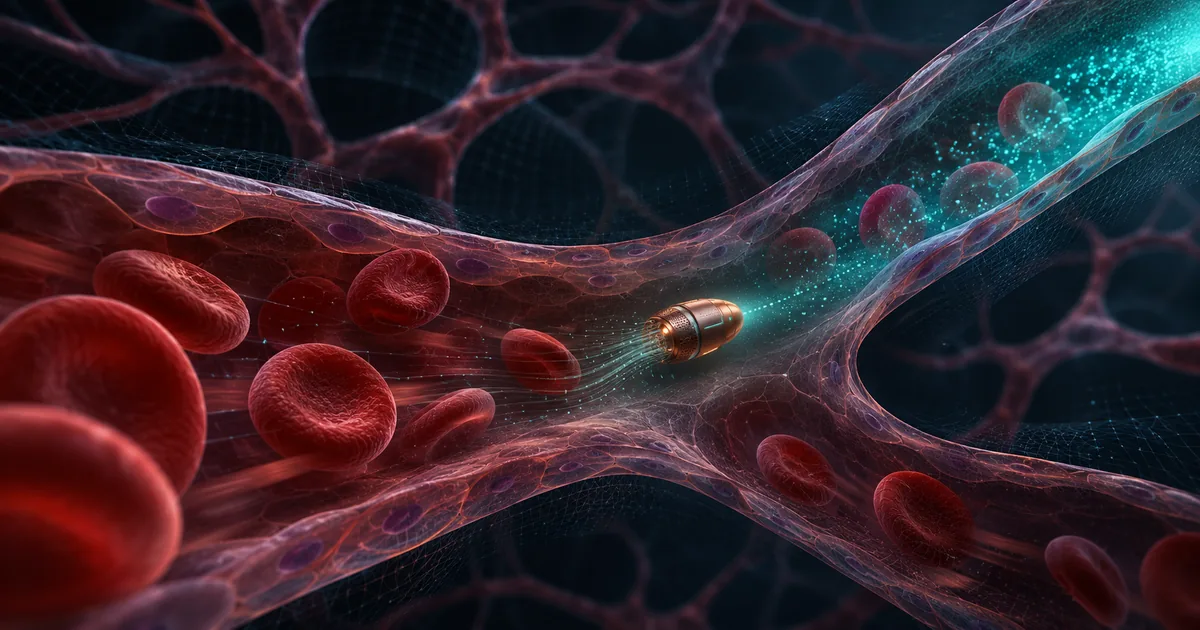
In a physically grounded but deliberately simplified capillary simulation, a reinforcement-learning policy navigated by a chemical gradient across a range of robot sizes and flow-to-swim ratios. Only 560 of 2,400 separately trained runs succeeded, yet one transferred policy reached an overall 76.3% success rate across the tested parameter grid and later performed simulated blocking and unblocking tasks without retraining. No robot was tested in an animal or person.
A hard training problem with a transferable policy
Jannik Drotleff, Paul Hohenberger, Samuel Tovey and colleagues published the peer-reviewed study in Scientific Reports on 3 November 2026. The model combines a branching capillary geometry, lattice-Boltzmann flow, red-blood-cell particles, diffusion and decay of an ATP-like chemical signal, plus Brownian motion and robot propulsion.
Thirty agents were trained for each parameter combination, with ten robots per agent. Success required at least eight robots to reach within 20 micrometres of the source during a 20-second deployment. The sharp difference between per-combination training and the transferred policy suggests that optimisation difficulty—not only physics—limited many failed runs.
What the learned behaviour reveals
Most successful policies converged on a run-and-rotate strategy. Mirroring the environment reversed the dominant rotation direction, evidence that the asymmetrical flow field influenced the learned preference rather than the algorithm simply hard-coding one handedness.
For the intervention demonstrations, the same policy moved swarms toward specified sources to reduce flow or clear model obstructions. The authors explicitly treat localised chemical-source placement as a task specification, not a demonstrated in-vivo capability.
Why this is not yet a medical result
The network is quasi-two-dimensional, vessel walls are rigid, red blood cells are simplified rigid spheres, flow is steady rather than pulsatile, and particle–flow coupling is one-way. The intervention signal, absolute sensor sensitivity, biocompatibility, propulsion, manufacturing and removal of robots remain open engineering and biological problems.
The simulation is valuable because it exposes a failure boundary and reports unsuccessful training, not because it predicts immediate treatment. The next evidence step is increasingly realistic three-dimensional modelling followed by benchtop flow systems, with pre-specified safety and retrieval criteria before any in-vivo study.
Primary sources and version boundary
Published figures and claims are reported from the linked source versions. The featured researchers and organisations did not commission or endorse this coverage. This article is independent Discovery News reporting and is not a Haivian audit result.
Independent validation
Need a computational claim examined before publication?
Haivian offers scoped research audits with explicit evidence, limitations and accountable human sign-off. Payment does not purchase a positive result or publication.
Explore research audits