A Graph Network Predicts the Electron Density Behind Materials Calculations
EdenGNN predicts charge density and augmentation occupancies for projector-augmented-wave calculations, with reported speedups above an order of magnitude and a strict reproducibility boundary.
Direct answer
What does EdenGNN accelerate?
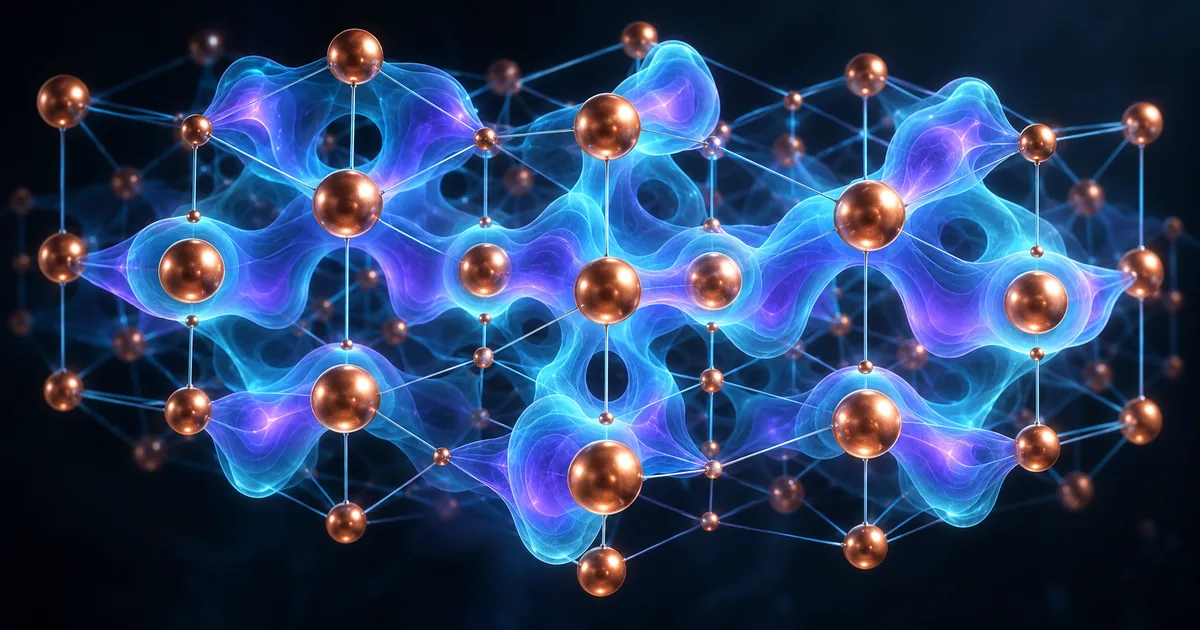
EdenGNN predicts a material's three-dimensional charge density and augmentation occupancies from atomic structure, providing inputs for electronic-structure calculations that would otherwise depend on more expensive density-functional-theory workflows. The reported model is a surrogate for a specified computational setup, not a replacement for physical validation or every DFT calculation.
What the model contributes
Xiwen Li, Zaizhou Xin, Hongyu Yu and colleagues published the peer-reviewed work in Nature Machine Intelligence on 23 October 2026. Their equivariant graph neural network uses a basis expansion with trainable radial functions and a delta-learning strategy intended to capture charge transfer. It predicts both charge density and augmentation occupancies, enabling projector-augmented-wave electronic-structure calculations.
The authors report that the approach is more than an order of magnitude faster than existing generalizable machine-learning charge-density methods. EdenGNN-Uni, trained on Materials Project data for non-magnetic structures across the periodic table, reproduced band structures for most unseen materials in a GNoME test set and outperformed the universal ML Hamiltonian comparisons reported in the study.
Why equivariance and charge density matter
A crystal rotated in space should not become a different material. Equivariant networks encode how geometric quantities transform, reducing the burden on a model to relearn the same physical relationship in every orientation. Predicting charge density is also useful because it sits upstream of multiple electronic properties rather than targeting only one downstream label.
That generality is attractive for high-throughput screening, where millions of hypothetical structures can make direct calculations expensive. But speed creates a new assurance problem: a fast surrogate can propagate a subtle setup mismatch across far more candidates than a slow calculation.
The reproducibility boundary is explicit
The authors provide code, datasets, model weights and source data. They also warn that charge density depends on calculation parameters such as cutoff energy, accuracy settings and the pseudopotentials used for training. Applying the pretrained model therefore requires a consistent computational setup. That caveat is not housekeeping; it defines where the reported accuracy claims apply.
Independent validation should reproduce the published test splits, examine chemical regions underrepresented in training, test magnetic and out-of-domain structures separately, and propagate density errors into the specific properties used for decisions. Agreement on selected band structures is promising evidence, not a universal guarantee for every material or downstream calculation.
Primary sources and version boundary
- Li et al., Nature Machine Intelligence, version of record published 23 October 2026
- EdenGNN source code named by the paper
Published figures and claims are reported from the linked source version. The featured researchers and organisations did not commission or endorse this coverage. This article is independent Discovery News reporting and is not a Haivian audit result.
Independent validation
Need a computational claim examined before publication?
Haivian offers scoped research audits with explicit evidence, limitations and accountable human sign-off. Payment does not purchase a positive result or publication.
Explore research audits