Climate-paper audit reproduces key numbers but challenges the claimed fossil-fuel limit
Haivian reproduced key isotope results in a disputed climate argument, but found that they do not establish the paper's general fossil fuel bounds. Its review separates successful calculations from unresolved attribution assumptions.
Direct answer
What did the Haivian audit find?
Haivian has completed an audit of Jonathan Cohler and Willie Soon’s claim that carbon-isotope measurements mathematically rule out fossil fuels as the dominant explanation for rising atmospheric CO₂. Key numbers reproduce, but the audit finds that the general fossil-fuel bounds depend on assumptions the paper does not establish. It does not provide a new measurement of the true fossil contribution. Audited paper.
Haivian has completed an audit of Jonathan Cohler and Willie Soon’s claim that carbon-isotope measurements mathematically rule out fossil fuels as the dominant explanation for rising atmospheric CO₂. Key numbers reproduce, but the audit finds that the general fossil-fuel bounds depend on assumptions the paper does not establish. It does not provide a new measurement of the true fossil contribution. Audited paper.
Disclosure: This is Haivian’s account of its own audit, commissioned by Richard Janutka of Qonduit Limited, New Zealand. The audit service and Validation Journal share organizational control. Reviewers were AI from the same provider; the separate challenger inherited context and saw earlier work. This was not blind or external human peer review, and no author endorsement is claimed.
What reproduced
Carbon-12 and carbon-13 are stable forms of carbon whose relative abundance helps researchers investigate sources and exchange. A Keeling plot compares isotope composition with reciprocal CO₂ concentration. Under specified mixing conditions, its intercept identifies the composition of an added contribution.
The audit recovered the modern intercept near −13.2 parts per thousand from four Scripps stations. Seasonally adjusted annual results ranged from approximately −13.34 to −13.02, using the downloaded data vintage rather than the original author code and download. Scripps data.
The conditional arithmetic also holds: an effective signature of −13.2, fossil signature of −28 and natural signature of −8 give a 26% fossil weight in a positive two-component mixture. Choosing zero for the natural signature gives about 47.1%. Exact isotope-ratio corrections are small. Turning those calculations into physical bounds requires justified component signatures and mixing assumptions.
Exchange can change composition without adding carbon
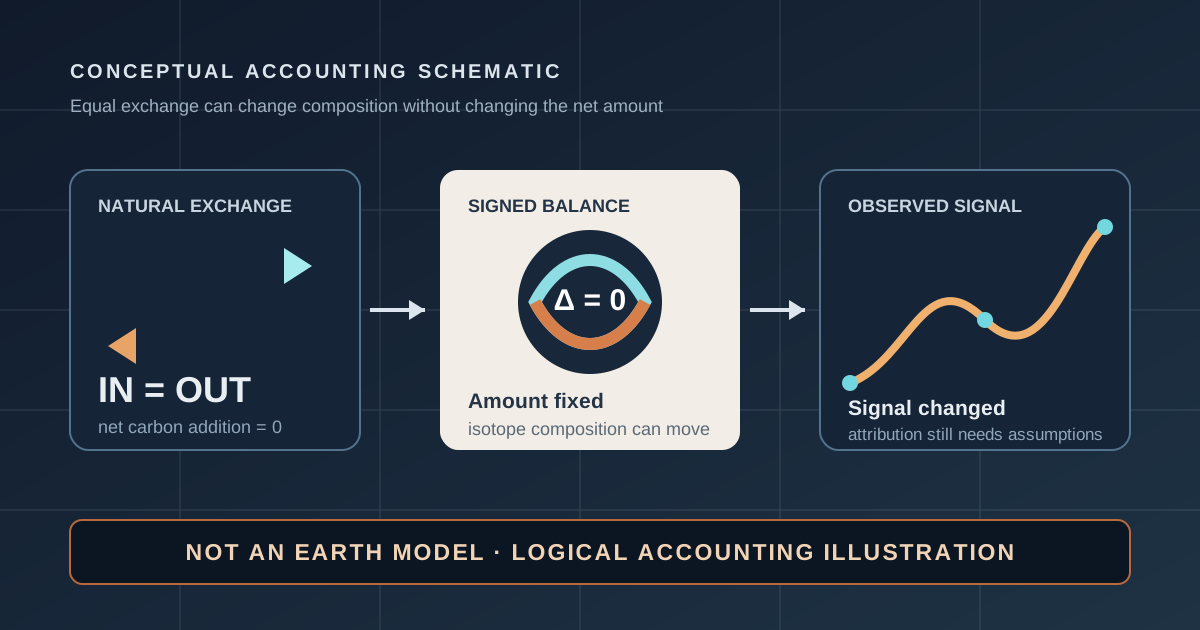
Imagine removing 100 tokens from a jar and replacing them with 100 having a different colour mixture. The count stays fixed; the composition changes. This is an accounting illustration, not an Earth model.
Carbon exchange can similarly change isotope composition without supplying net carbon. The authors explicitly include sinks. The issue is whether their net residual—a difference between inputs and outputs—can be treated as a positive mixture bounded by physical reservoir signatures.
The audit constructed synthetic examples where all net growth is fossil-origin growth yet the effective signature is −13.2. Natural exchange changes the isotope balance while adding no net carbon. The challenger checked the exact balance and extended the construction over time. These logical tests show why conservation alone does not supply the proposed bound; they do not reconstruct actual atmospheric history.
Historical records and residence time
The purported independent atmospheric evidence from Caribbean sponges also needs qualification. The cited analysis digitizes atmospheric ice, firn and air curves shown alongside sponge data; the isotope curve was scaled to the shallow-water sponge record. Exact digitization and handling of that scaling remain unresolved. This changes the claimed independence of the evidence, not the validity of the marine sponge measurements. Koutsoyiannis, §2, Böhm and colleagues.
The audit approximately recovered the paper’s short-lifetime calculations under a one-way model and an assumed 2025 emissions input. These are not measured fossil inventories. Carbon can leave the atmosphere and later return: first-exit residence is different from the response of an exchanging system to an added pulse. A short first stay does not require a short whole-system response. Emissions data.
An unresolved numerical discrepancy
Several CO₂ comparisons with the van Wijngaarden–Happer model substantially reproduced, including weaker annual-growth agreement after removing a shared trend. Matching a broad rise alone does not establish causation; poor short-term performance alone does not establish a negligible long-term human contribution. The reconstruction used the model’s governing equation to address a missing isotope factor in its printed discrete formula. Competing model.
The reported isotope correlation of −0.45 after trend removal was not recovered: the audit’s annual reconstruction gave about −0.075. Exact author inputs were not located, and sampling, calibration and regional-record splicing remain relevant. This discrepancy is unresolved, not disproved or evidence of fabrication.
What the audit establishes
Separate mathematical and source reviews, public-data reconstructions and the disclosed AI challenge support a scoped conclusion: the claimed general mathematical falsification is not established. Successful calculations remain credited. Some historical methods and exact inputs remain unavailable, and uncertainty across calibration, chronology and model assumptions was not fully propagated. No competing model or complete official attribution assessment was validated.
The validation article and public evidence supplement provide the detailed findings, review disclosures, scripts and saved results, with synthetic examples distinguished from observations.
Bounded audit pathway
Need a claim examined before publication?
Haivian offers scoped research audits with explicit evidence, limitations and accountable human sign-off. Payment does not purchase a positive result or publication.
Explore research audits