AutoDNA Orchestrates 11,000 Laboratory Steps. Autonomy Still Has a Boundary.
A Nature paper reports an AI-native biomolecular laboratory coordinating more than 20 instrument types across four demonstrations, while people still handle maintenance and replenishment.
Direct answer
What did the AutoDNA laboratory demonstrate?
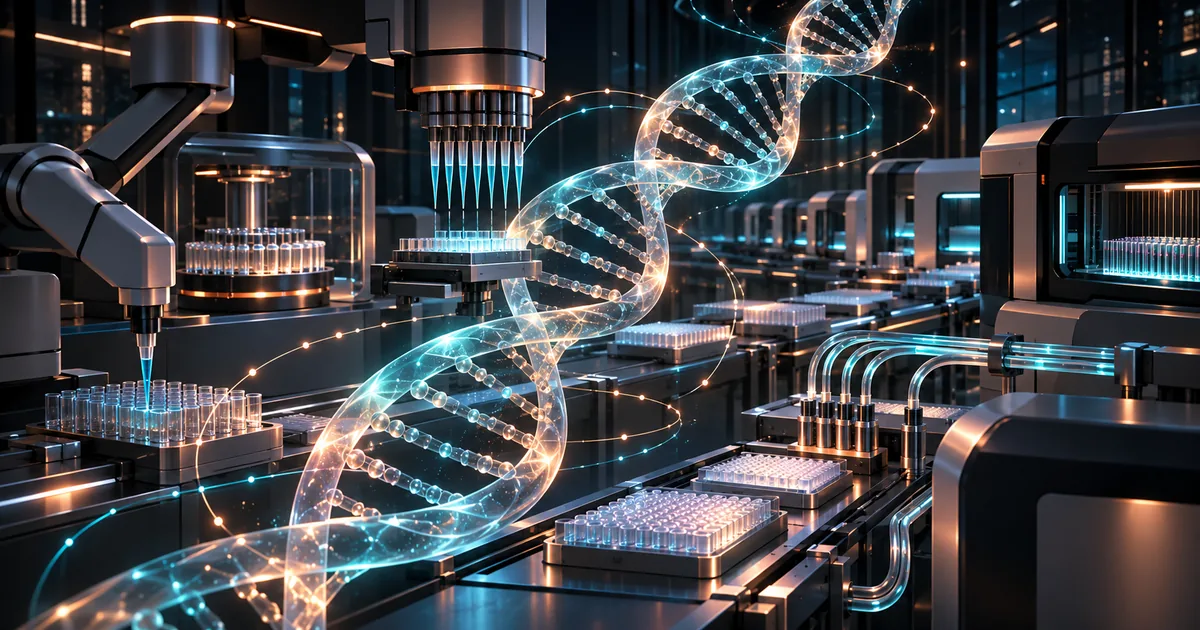
AutoDNA coordinated more than 20 types of laboratory instrument across more than 11,000 steps for nucleic-acid synthesis, transcription, amplification and sequencing. In four demonstrations, the authors report expert-comparable enzymatic DNA-synthesis yields, 3.2-fold faster concurrent protocol execution, exact recovery in a DNA data-storage cycle and identification followed by validation of a clinically detected KRAS G13D mutation. That is evidence of broad orchestration inside one engineered platform—not proof that an AI can independently run any biological laboratory.
What the researchers built
M. Wu, Z. Wang, J. Wang and colleagues describe AutoDNA in Nature's version of record published on 4 November 2026. The system was co-designed with its experiments and instruments rather than added as a chat layer over an unchanged laboratory. It accepts multiple users' requests, plans workflows, assigns instruments and monitors execution across an end-to-end automation stack.
The paper's four applications test different parts of that stack: enzymatic DNA synthesis, concurrent experiment scheduling, DNA information storage and a cancer-mutation workflow. The range matters because a single successful protocol would say little about whether the orchestration layer can coordinate incompatible timings, instruments and objectives.
Why the evidence is interesting
Laboratory autonomy is often presented as a reasoning problem. AutoDNA makes the engineering dependency visible: models, workflows, consumables, instrument interfaces and physical handling have to work together. The reported 3.2-fold concurrency result is therefore as much a scheduling and systems claim as an AI claim.
The authors provide study code and data records, including sequencing outputs and agent-related outputs. Those materials improve inspectability, although reproducing a full laboratory result still requires compatible hardware, reagents, calibration and operating procedures.
What remains unproven
People still perform hardware maintenance and replenish reagents and labware. The four demonstrations were conducted on the authors' integrated platform; they do not establish portability to a different laboratory, resilience to every instrument fault, or safe unsupervised use in clinical decision-making. The mutation demonstration validates a detected variant within the reported workflow, not a general diagnostic service.
Independent replication should separate software portability from hardware-specific performance, publish failure and intervention rates, and test how the platform responds when instruments drift, samples are poor or a plan becomes unsafe. An autonomous laboratory needs an audit trail for every physical action, not only an impressive final yield.
Primary sources and version boundary
- Wu et al., Nature, version of record published 4 November 2026
- AutoDNA study code
- Versioned study data and code archive
Published figures and claims are reported from the linked source versions. The featured researchers and organisations did not commission or endorse this coverage. This article is independent Discovery News reporting and is not a Haivian audit result.
Independent validation
Need a computational claim examined before publication?
Haivian offers scoped research audits with explicit evidence, limitations and accountable human sign-off. Payment does not purchase a positive result or publication.
Explore research audits